STUDY OF THE NZL PATTERNS USED IN AUSTRALIA.
By David Coath
Background to the NZL Introduction
The New Zealand Loan and Mercantile Agency (NZL) had offices up and down the length of Queensland, and indeed around Australia. Many of these offices had perforating devices with the letters NZL and to make matters more confusing the patterns produced by these devices are in most cases quite similar. They used these devices to create perfins in both postage and revenue stamps.
I have been working on an online catalogue of perfins on Australian revenue and railway stamps entitled “The Private Revenue Perfins of Australia” with well known revenue collector Dave Elsmore from Queensland. We are building the catalogue State by State starting with Queensland and this meant collecting information about Queensland users including the users of the NZL patterns.
Because of the link to New Zealand these NZL patterns have always been of special interest to New Zealand perfin collectors who consider these to be New Zealand patterns. Therefore in order to assist with this research I purchased a copy of “New Zealand Stamps with Perforated Initials” (NZSWPI) by R D Samuel (2nd Edition 2010). This is an excellent catalogue and Samuel and the editors bring the New Zealand patterns alive with many images, as well as a pocket history of the New Zealand perfin users. The scope includes reference to patterns used in New Zealand and abroad, including Australia.
For the patterns on Australian stamps Samuel relies heavily on, “Handbook of Australian Perfins” (HAPP - Mathews 2003) and to a lesser extent “Commercial Perfins of Australia” (CPA -Grant and Mathews 1992 ) and these extracts are in some instances cross referenced with somewhat dated and disjointed references to Samuel’s first edition (1968) and to images provided by NZ perfin pioneer David Dell (1993). In short none of these publications / references, in isolation or indeed collectively; as is attempted in Samuel’s catalogue, adequately cover the rather complex web of offices, devices and patterns that are the NZL groups.
In particular the way that Mathews categorises similar patterns as “types” of a single pattern is unhelpful and often misleading, especially when you are trying to build a definitive list of the patterns, devices and their locations. In many cases the patterns within the NZL groups are similar but they have been made by different devices in remote locations. Given this there is a need for high quality images of patterns so that collectors can confirm which pattern is which. Unfortunately both CPA and HAPP and therefore NZSWPI have many poor or imperfect pattern images and therefore the pattern groups are littered with miss reported usage dates and other errors.
As far as I can determine there are only 3 NZL patterns used on revenue stamps but in order to describe these in context I found it necessary to clarify the entire pattern groups, build usage timelines and provide revised images of all patterns.
For numbering I have used HAPP numbers and added to the catalogue number sequence as required. For patterns that are found on revenue stamps and therefore fall within the scope of Dave Elsmore and my new web based catalogue, I have used the identification system which is Elsmore/Coath number or EC.#. It actually uses letters not numbers and because these EC “numbers” are State based I will specify the State in the listing, for instance for the first NZL found on a revenue stamps it is denoted as EC NZL.a (Qld).
-----------------------------
NZL Pattern Group
The reference images for the NZL group in CPA were generally rather poor. In particular the images provided for NZL.1,.2 and .3 and to a lesser extent .4 and .5 were not representative of the actual patterns. In HAPP the images were re drawn and they were better overall but the images for NZL.4,.5 and .9 were still incorrect.
This would have certainly sown confusion amongst collectors, which would have lead to misreporting of usage dates and issues for patterns within this group.
In addition some of the start dates for usage seem rather arbitrary and convenient. For instance the patterns NZL.2 and .3 both list usage from 1900. Not only is this not supported by postmark evidence that I have seen but it predates the earliest known application of 1906. Both of these early start dates are found in CPA and it is possible that this start date was based on the issue date of some Queensland stamps found with the pattern.
Accordingly you will note that the usage dates that are quoted differ from those in CPA/HAPP which were reproduced in Samuel 2 nd Edition.
---
NZL.1
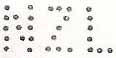
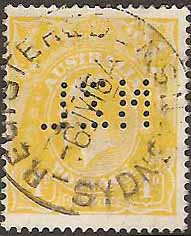
Described in both CPA and HAPP as having 2 types this is an attempt to describe 2 patterns produced by 2 separate devices, one in Sydney and the other in Melbourne.
NZL.1 is closest to an image of the Sydney device which has larger pins and produces a clearer strike than the Melbourne device which has finer pins. The Melbourne device is listed in HAPP as NZL.8.
Both are single head devices and there is no variation that could be defined as representing a 2 nd type of either pattern.
NZL.1 is found on postage stamps of New South Wales and Australia.
Usage NZL.1 1912-1938
---
NZL.2
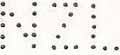
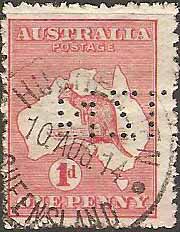
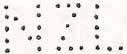
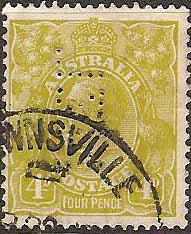
Type 1 1907-1914 Type 2 1930-1936
This is listed as a single device but curiously with usage periods of 1900-02 and 1935-36. Usage in both periods seems to have centred in Townsville and nearby towns including Hughenden.
Close examination shows slight variation in the pattern in the different usage periods. Most distinctive is the upright of the L which in the earlier usage tends to lean back towards the top and in the later usage tends to lean forward.
Given the very similar nature of these patterns and the shared location it is difficult to define them as 2 patterns.
Most likely it is a single device that was discontinued and much later reintroduced following some minor alterations/repairs.
The pattern is found on postage stamps of Queensland and Australia. The later type 2 is only found on postage stamps of Australia.
Usage NZL.2
EC NZL.a (Qld)
---
NZL.3
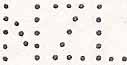
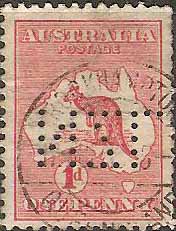
A straight forward pattern of a device that was in use for a long period of time. As mentioned above the early usage is doubtful and not supported by postmark evidence.
The device was most likely located in the Rockhampton office as these postmarks predominate. Blackall and Longreach postmarks are found but these towns are on the east west road running inland from Rockhampton so these postmarks are consistent with the device being located at Rockhampton.
The pattern is fairly consistent over its long life but in about 1932 it alters slightly. This is noticeable in the change to the shape of the base of the L. In pre 1932 usage the base is generally straight but with the centre pin slightly below the other pins. In the post 1932 usage the last pin of the base of the L is lower.
Late usage after 1953 is characterised by many missing pins especially in the N and Z.
Type 1 is found on postage stamps of Queensland and Australia as well as Queensland revenue stamps. Type 2 is found on postage stamps of Australia and Queensland revenue stamps.
Given that both patterns are found in the same location and the difference is small the variation in the pattern is best described as 2 types of a single pattern, with the following usage:
Usage NZL.3
Type 1 1912-1932
Type 2 1932-1957
---
NZL.4
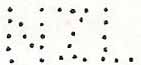
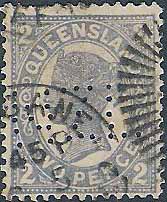
This is a rare pattern made by a device located in the Brisbane office. It is characterised by a very bent right leg of the N near the intersection with the cross bar of the N. It is somewhat similar in style and scale to NZL.9 and the new one I have listed which would be NZL.10. It is possible that this NZL.4 device was later modified to become .9 and .10.
NZL.4 is only found on postage stamps of Queensland.
Usage NZL.4 1906-1910 (?)
---
NZL.5
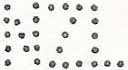
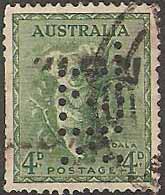
This is a distinctive pattern, larger than most of the other NZL’s and it has large clear holes.
The device is attributed to the Brisbane office but I doubt this as its usage period overlaps with the NZL.6 device which is known to have been located in this office.
More likely it is a Sydney device that replaced the NZL.1 device which ceased to be used in about 1938. All issues that I have seen show Sydney style roller cancellations. HAPP (update #1 October 2005) lists a Sydney postmark of 1940 but fails to correct the location of the device from the Brisbane office.
This pattern is only found on postage stamps of Australia.
Usage NZL.5 1937-1940
---
NZL.6
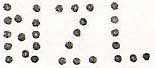
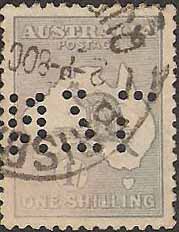
Another distinctive NZL pattern with large clear holes and a unique cross bar in the N which starts very high and finishes very low in relation to the legs of the N.
This is another Brisbane device with usage reported from 1906 until 1950. This early usage seems unlikely as I am yet to see the pattern on a Queensland issue and the large holes combined with the size of the pattern would have almost consumed one of these small Queensland State issues. The earliest postmark I can find on a Commonwealth issues is 1917.
This pattern is only found on postage stamps of Australia.
Usage NZL.6 1917-1953
---
NZL.7
Doubtful
Firstly let me say that I have never seen an example of a pattern like the one listed as NZL.7. It is reported in CPA and unlike most of the other NZL patterns the exact same image is used in HAPP.
It is reported to have been used in 1907 but the pattern is very large and would have been unsuitable for the small format Queensland issues of this time.
Oddly the pattern is described in CPA as having 2 types which is not a very common feature for non service punctures listings in CPA.. The pattern is not listed in Samuel’s first edition which only lists the patterns we know of as NZL .1, .3, .5 and .8.. Further it is not mentioned in Dell’s articles on NZL’s in early issues of the South Pacific Perfin Bulletin (SPPB). In particular Issue #1 of 1986 in which he notes the 4 patterns listed in Samuel and lists 2 more. The first one is later listed in CPA as NZL.6 and he also shows a partial of a pattern that is most likely the pattern I describe as NZL.10. Furthermore the pattern described as NZL.7 is not listed in the Members Survey of Queensland patterns in SPPB #4 of June/September 1987 and it is not noted as a new pattern in any SPPB that pre dates the issue of CPA in 1992. This means that Grant/Mathews most likely had a report of the pattern and image in their source documents from the late Joe Purcell (refer the Foreword and Acknowledgements in CPA page i).
The NZL.7 pattern has characteristics similar to NZL.9 and patterns of similar appearance which I describe (CPA/HAPP numbers used for uniformity only as they have not been confirmed by John Mathews) as NZL.10 and .11. The image of .7 is however of a larger scale than the .9/.10/.11 patterns. I would attribute this to an error in the storage, copying and/or reproduction of the image. Such “photocopier”errors, as I have heard them called, are fairly common in HAPP and seem to occur when images are stored in a particular software format and then reproduced using slightly different publishing software.
To conclude, I would say that in the absence of someone producing an example of one or more of the types of NZL.7 that we can say that the pattern does not exist in the form of the image as presented in CPA and HAPP.
Usage NZL.7 doubtful
---
NZL.8
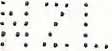
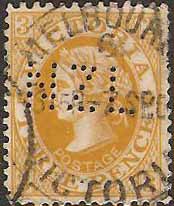
This pattern was not listed in CPA but was subsequently listed in HAPP. This is most likely due to confusion between this pattern and NZL.1 which is a Sydney device with a similar pattern. The main difference is that the .1 pattern has larger diameter pins and therefore makes a pattern with larger clear holes.
NZL.8 is a Melbourne device that is found on Victorian issues from about 1908 and Commonwealth issues until 1948. Some usage on NSW issues has been reported but this is late in the immediate pre Commonwealth period when cross use of States stamps is more common.
Usage NZL.8 1908-1948
EC NZL.b (Qld)
---
NZL.9
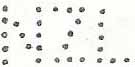
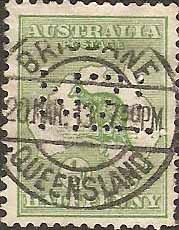
As with NZL.8, NZL.9 was not listed in CPA but was included in HAPP. The image of NZL.9 in HAPP is slightly distorted from the true pattern and there are a number of other similar unlisted patterns to .9 and this would have lead to confusion with this pattern.
NZL.9 is a Brisbane device and it was only in service in the early Commonwealth period. The device was apparently not very robust as there is evidence of missing pins in the base of the L in early (1913) usage.
HAPP states that it was used between 1910 and 1957. This is clearly not the case and is further evidence of the confusion with usage dates that has been sown by the poor quality of some NZL images in both CPA and HAPP. NZL.9 is not found on Queensland issues and the only NZL usage as late as 1957 is limited to the NZL.3 pattern. Admittedly .9 and .3 are similar in scale but not in pin location.
This pattern is found on postage stamps of Australia and revenue stamps of Queensland.
Usage NZL.9 1913-1914
---
NZL.10
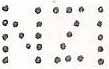
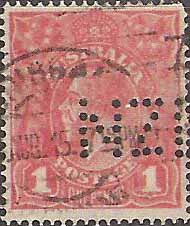
This pattern shares many similarities with NZL.9 but it is a later device (1915) and it has a characteristic angle in the base of the Z which is not present in .9. It is possible that this pattern was the one recorded by Dell in Issue #1 of SPPB but it is impossible to confirm as the pattern shown was missing many pins. In fact the only NZL.10 that I have seen is also a partial as the base of the L is not complete.
NZL.10 was another Brisbane device and it is possibly a modification or repair of the NZL.9 device. It was very short lived being replaced by the NZL.6 device in about 1917.
Usage NZL.10 1915
EC NZL.c (Qld)
---
NZL.11
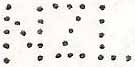
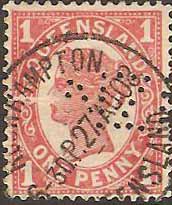
NZL.11 was located in Rockhampton and is only found on the issues of Queensland. It is most likely to be the device that was the subject of the March 1906 Application and Approval.
Late usage is characterised by many blind pins and it is clear that by about 1910 the device was no longer sound. It was replaced in 1912 by the NZL.3 device.
Given the similarity in scale to the NZL.9 and .10 patterns it is possible that .11 is actually the parent device to these later Brisbane device(s).
NZL.11 is found on postage stamps and revenue stamps of Queensland.
Usage NZL.11 1906-1911
Summary of Usage of NZL Group
City/Town Pattern # My usage HAPP usage
Sydney NZL.1 1912-1938
NZL.5 1937-1940
Melbourne NZL.8 1908-1948 1906-1945
Brisbane NZL.4 1906-1910(?) 1905-1910
NZL.7 Doubtful 1907
NZL.9 1913-1914 1910-1957
NZL.6 1917-1949 1906-1950
Rockhampton NZL.11 1906-1911 1910-1957
NZL.3(2 types) 1912-1957 1900-1950
Townsville NZL.2(type 1) 1907-1914 1900-1902
(type 2) 1930-1936 1935-1936
Conclusion:
In the study of these NZL pattern groups I have looked at thousands of these patterns but it is entirely possible that there is evidence that would add to this study and indeed contradict some of my findings.
I am happy to share my pattern images with anyone who would like a copy of them so just drop me an email or a letter.
Once you have sorted out your NZL’s I would be keen to hear what you find.
References:
Commercial Perfins of Australia-Grant/Mathews (1992)
Handbook of Australian Private Perfins– Mathews (2003)
HAPP Update #1 October 2005- Mathews
HAPP Update #2 Unissued – Mathews
New Zealand Stamps with Perforated Initials-RD Samuel (2010)
South Pacific Perfin Bulletin various articles
Bold Century-The New Zealand Insurance Company Limited 1859-1959
E: David Coath